If you moved from a tier 2 city to a tier 1 city like I did, there is a high chance you faced a plethora of water-related problems. For me, it ranged from my hair being very frizzy, to my skin becoming harsh, to finding scales on taps and utensils, to clothes feeling stiff after a round of washing and to changing shampoos one too many times because they simply refused to lather well no matter what I did.
This is not your problem or something you can control. All these effects are common implications of water being too hard. This generally happens in tier 1 or metropolitan cities because the main source of water there is borewells.
This water, before reaching your tap, travels through rock, soil and pipes, making it high in calcium and magnesium. Although naturally occurring water does have calcium and magnesium in adequate amounts, this water has more of that, in different compounds.
What is hard water? Where does hardness come from?
Hard water is not the same as impure water. Remember how it’s been mentioned before that naturally occurring water carries essential minerals like calcium and magnesium. The water that has an adequate amount of these minerals is beneficial to the body. Hard water has more of that, more than what our hair, skin, clothes and appliances need.
Hard water has a high amount of dissolved minerals like calcium and magnesium. Let’s try and understand how water becomes hard. When rain water falls on the ground, it has a long journey before it reaches your tap. It travels through rock, soil and when it does that, it dissolves calcium and magnesium on the way. Many sedimentary rocks contain calcium and this is how it gets dissolved in the water as well.
Borewell water, which is one of the major sources of water in any city, is underground first, through a tap later. This is why borewell water has high amounts of calcium and magnesium. After this, it also travels through pipes before it reaches the tap. All of this adds up to the problem of making water hard.
Is hard water harmful? Hard water is not unhealthy. Having said that, experiencing hard water everyday can be irritating to you, to the skin and to your hair. Since hardness isn’t the same as TDS, it’s not necessarily unhealthy.
What does a hard water softener do? How does it work?
A water softener does one job: it takes the hardness out of your water, so you stop seeing scale everywhere.
How it works: Softeners use a process called ion exchange. Think of it as a swap, and it happens in four steps.
- The beads: Inside the softener is a tank full of tiny beads. These beads are loaded with sodium.
- The swap: When hard water flows past, the beads grab the calcium and magnesium and give out sodium in return.
- The result: The water that comes out no longer has the calcium and magnesium that cause scale. It’s soft.
- The recharge: After a while, the beads are full and can’t grab any more. The softener then washes them with salty water, which clears out the hardness and loads them with sodium again, ready for the next round.
Softeners are usually fitted at the main inlet or the overhead tank, so the whole house gets soft water: the bath, the laundry, the geyser and the kitchen.
One of the other problems of having hard water at home is that it shortens the life of an RO membrane if you have a water purifier. The scale build-up that the hard water has tends to reduce RO membrane’s life. This is also why a softener becomes helpful, so that you don’t need to keep replacing your purifier’s filters frequently.
What it doesn’t do: A softener isn’t a purifier. It swaps ions instead of removing them, so your TDS doesn’t drop much. It doesn’t deal with bacteria and viruses either. Because it adds a little sodium, softened water isn’t meant to replace purified drinking water.
Is softened water the same as RO-treated water?
No, though they’re often confused. Here’s how they differ.
| Water softener | RO purifier | |
| What it targets | Calcium and magnesium (hardness) | Dissolved solids in general, including hardness ions |
| How it works | Ion exchange: swaps hardness ions for sodium | A membrane under high pressure leaves dissolved solids behind |
| Effect on TDS | Little change | Brings TDS down sharply |
| Where it’s used | Whole house, at the inlet or tank | At the point of use, for drinking water |
| Main goal | Protect your pipes, appliances, skin and hair | Make drinking water safe and pleasant to drink |
RO does remove calcium and magnesium along with the other dissolved solids, so the drinking water that comes out of it isn’t hard. But RO is installed at one point, usually in the kitchen, so it won’t save your hair, your clothes or your geyser.
Are both softeners and RO needed?
It depends on what you want to fix. An RO purifier will suffice if your main concern is making your drinking water healthy. RO removes the TDS. If you want to remove the scale-build up and make your hard water soft, you may have to get a softener, which will do the job for you. RO does not treat water that is used for bathing, washing clothes etc. Only a softener can do that.
In one of the rare situations where your water is very hard, then both are suggested. The scale build-up can also harm an RO membrane which is why using an RO for your drinking water needs and a softener for other purposes helps.
DrinkPrime’s purifiers to the rescue
Hard water, high TDS and the germs you can’t see all show up together in most metro homes. This is where DrinkPrime comes in.
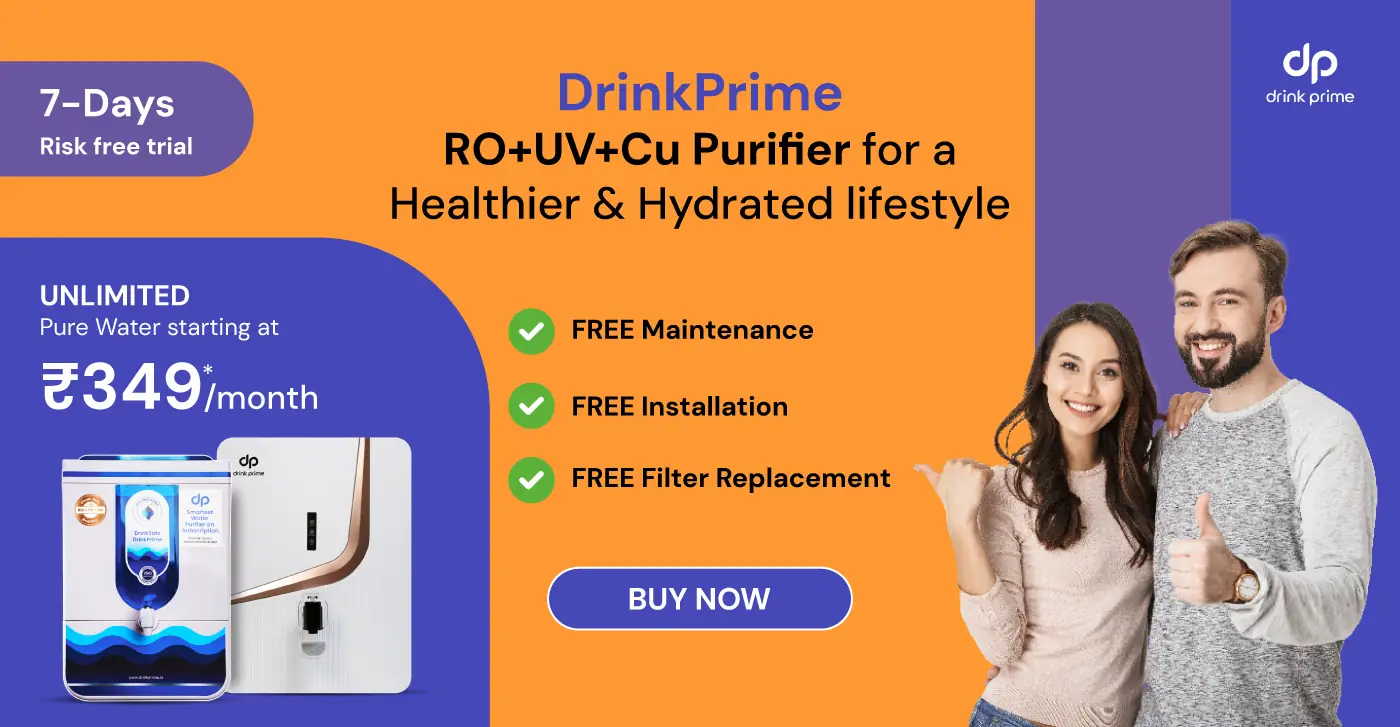
What it is: DrinkPrime offers water purifiers made for your city’s water, on a rental basis.
Multi-stage purification: DrinkPrime purifiers follow a multi-stage process, with a sediment filter and pre-carbon, followed by RO, UV, post-carbon and a mineraliser. This takes care of dirt, chlorine and odour, dissolved solids, bacteria and viruses, and adds the essential minerals back. DrinkPrime also doesn’t let part of your tap water skip the RO stage, so no impurities are left behind.
The variants:
- DrinkPrime Copper: Infuses the water with controlled doses of copper, and adds calcium and magnesium back.
- DrinkPrime Alkaline: Has an alkaline cartridge that balances the water’s pH.
- DrinkPrime Mineral+: Adds back the good minerals that RO removes.
- DrinkPrime UV: Made for homes with TDS below 200 ppm. It has UV only and no RO stage, so it isn’t meant for hard, high-TDS water.
- DrinkPrime Under-The-Sink: Made for compact kitchens, and installed inside a cabinet with only a small tap visible.
The cost and rental plans: The monthly subscription starts at ₹349/month, with a refundable security deposit of ₹1,500. (Only the Under-The-Sink model has a security deposit of ₹1,999.) There’s no hefty upfront cost.
Delivery, installation and relocation: The rental covers the product, delivery, installation, maintenance and relocation. If you move homes, or cities, the purifier moves with you. If your purifier runs into an issue, DrinkPrime will look into it at no extra charge. You can make recharges on the app, which also helps you track your filter’s health and total water usage.
DrinkPrime’s variants for Chennai and Kolkata, where water is very hard
Some cities need a little extra. In Chennai and Kolkata, the water is very hard, so DrinkPrime adds stages that match what’s in the water there.
- Chennai: The purifier comes with an anti-scalant. This helps stop scale from building up inside the purifier, so the RO membrane lasts longer and keeps working well.
- Kolkata: The purifier comes with both an anti-scalant and an iron remover. Kolkata’s water often carries excess iron on top of the hardness. Iron can leave a metallic taste and yellow or brown stains, and the iron remover takes care of it.
Same purifier, with the stages that fit your city.
Get 7 Days Risk Free Trial
Conclusion
If you’re in a metropolitan area and you experience any of all of the above situations, you don’t need to scratch your head over it. One of the easier ways of knowing if your water is hard, try to notice the scale build-up on pipes or kettles and that tells you if you do.
If your water is not hard, that doesn’t necessarily mean your water is safe and pure. Using an RO purifier is still recommended. For hard water, you can get a softener and it will take care of the scaling issues for you. As far as the purifier is concerned, DrinkPrime will make sure your water is safe, healthy, and pure. At DrinkPrime, you don’t have to worry about the cost because every repair or a technician’s visit is free of charge.
If you’re in Chennai or Kolkata, DrinkPrime’s anti-scalant and iron removal filters will take care of the water issues for you.
Frequently Asked Questions
1. What is hard water?
Hard water has a higher concentration of calcium and magnesium than required by your body.
2. Is hard water safe to drink?
Hard water is not exactly unsafe to consume. But, there’s a catch. Your body does need an adequate amount of Calcium and magnesium which, if present in a higher concentration, cause the hardness. If your water is hard, it can have other dissolved solids as well, which warrants the use of RO.
3. How do I know if I have hard water?
If you find white scales on taps and utensils, if your soap and shampoo don’t lather, if your skin and hair become hard and if your clothes look stiff and dull after washing.
4. What does a water softener do?
It removes calcium and magnesium through ion exchange, swapping them for sodium, so you don’t get scale and your soap works properly.
5. Does RO remove hardness?
Yes, in your drinking water. RO removes dissolved solids, including calcium and magnesium. But since RO is used for drinking water purposes and not overall usage, RO doesn’t soften your house’s water supply. For that, you need to have hard water softener.
6. Do I need both a softener and an RO purifier?
Not always. RO is enough for drinking water. A softener protects your appliances, skin and hair. In very hard water, many homes use both.
7. Does hard water damage RO purifiers?
Scale can build up on the RO membrane and shorten its life. That’s why some purifiers include an anti-scalant stage.
8. What is an anti-scalant in a water purifier?
It’s a stage that helps prevent scale from forming inside the purifier. DrinkPrime’s Chennai variant comes with one.
9. Why does the Kolkata variant have an iron remover?
Kolkata’s water is very hard and often carries excess iron as well. The iron remover takes care of it, alongside the anti-scalant.