Are you thinking of purifying your water at all? If yes, then which way do you go: a water filter or a water purifier?
Back in Mysuru, my mom has a water filter, and for her, for now, it seems to be enough. She has never complained, and the water tastes fine to her. So the big question is: who needs a purifier, and who can get by without one?
To answer that, we first need to understand that a filter and a purifier are not two names for the same thing. They look similar, sit in the same corner of the kitchen and are often used interchangeably, but they solve different problems. In this guide, we’ll look at what each one does, who it suits and how to choose.
What Is a Water Filter?
The definition: A water filter is a device that physically removes dirt and particles from your water. Think of it as a sieve. It catches what’s visible, or what’s floating in the water, and lets the water pass through.
What is it made of? Most water filters have a few simple components, such as a sediment filter, activated carbon and sometimes a candle filter. Water passes through these one after the other, usually with the help of gravity. There’s often no electricity involved.
The stages:
- Sediment filter: This catches dirt, sand, rust and other visible particles.
- Activated carbon: This takes care of chlorine, bad odour and some chemicals, which improves the taste.
- Candle filter (in some models): This is a finer stage that blocks more suspended particles.
What does it remove? Dirt, sediment, suspended particles, excess chlorine and odour.
What doesn’t it remove? Sediment filters, candle filters and activated carbon are effective stages, but they don’t remove dissolved impurities. This means a filter won’t bring down your TDS. Most basic filters also don’t neutralise bacteria and viruses, unless the model has a specific stage for it.
Is it enough? It can be, in the right situation. If your water comes from a source you trust, it’s already fairly clean and the TDS is low, a filter can be a basic first step. But here’s the catch. Water that looks clear can still carry germs, and a filter can’t tell you what’s dissolved in it.
What Is a Water Purifier?
The definition: A water purifier is a device that makes your water safer to drink by removing or neutralising impurities, including the ones you can’t see. It goes beyond catching dirt. It deals with what’s dissolved in the water and what’s living in it.
The different types: The main types are RO (Reverse Osmosis), UV (Ultraviolet) and UF (Ultrafiltration). Each fixes a different problem. RO brings down dissolved solids, UV neutralises bacteria and viruses, and UF filters out microbes. Our guide on types of water purifiers covers them in detail.
The stages: Most purifiers today use a multi-stage process. It usually starts with a sediment filter and pre-carbon, followed by RO, UV, post-carbon and a mineraliser. The water goes through one stage after another, and by the time it reaches your glass, it has been treated for more than one problem.
What does it remove?
- Dissolved solids and salts, which brings down your TDS
- Bacteria, viruses and parasites
- Excess chlorine and odour
- With a mineraliser, calcium and magnesium are added back to the treated water
Who is it best suited for? Anyone whose water has a high TDS, comes from a borewell or tanker, or changes with the season. It also suits people living in metro cities, where water travels a long way before it reaches the tap. If you’re not sure what’s in your water, a multi-stage purifier covers more ground.
Bengaluru’s DrinkPrime offers a range of water purifiers that can be customized for your city’s water. All these purifiers are equipped with multi-stage purification processes which make your water clean, healthy and safe. DrinkPrime is present in 11 cities and among them, two cities’ water is quite different from the rest. They are Chennai and Kolkata. If you’re in either of them, you don’t have to worry about hard water or iron build-up. Chennai’s purifiers come with an extra tool, an anti-scalant which removes the scale build-up and Kolkata’s purifiers have the anti-scalant, along with the iron removal cartridge which removes the excess iron present in the city’s water.
Water Filter vs Water Purifier: What’s the Difference?
Let’s look at the key differences between a water filter and a water purifier. This would help you make an informed decision.
| Water filter | Water purifier | |
| What does it do? | Physically removes dirt and suspended particles | Removes or neutralises dissolved impurities and germs |
| Removes dirt and sediment? | Yes | Yes, through its pre-filtration stages |
| Reduces TDS? | No | Yes, with an RO stage |
| Deals with bacteria and viruses? | Usually not | Yes, with a UV or UF stage |
| Typical stages | Sediment, activated carbon, candle | Sediment, pre-carbon, RO, UV, post-carbon, mineraliser |
| Need electricity? | Often not | Usually yes, for RO and UV |
| Best suited for | Clean, low-TDS water from a trusted source | High-TDS or changing water sources, and homes that want complete protection |
DrinkPrime’s Types of Purifiers
DrinkPrime offers water purifiers made for your city’s water. All of them follow multi-stage purification. The range includes:
- DrinkPrime Copper: Infuses the water with controlled doses of copper, and adds calcium and magnesium back, along with multi-stage purification that includes RO and UV.
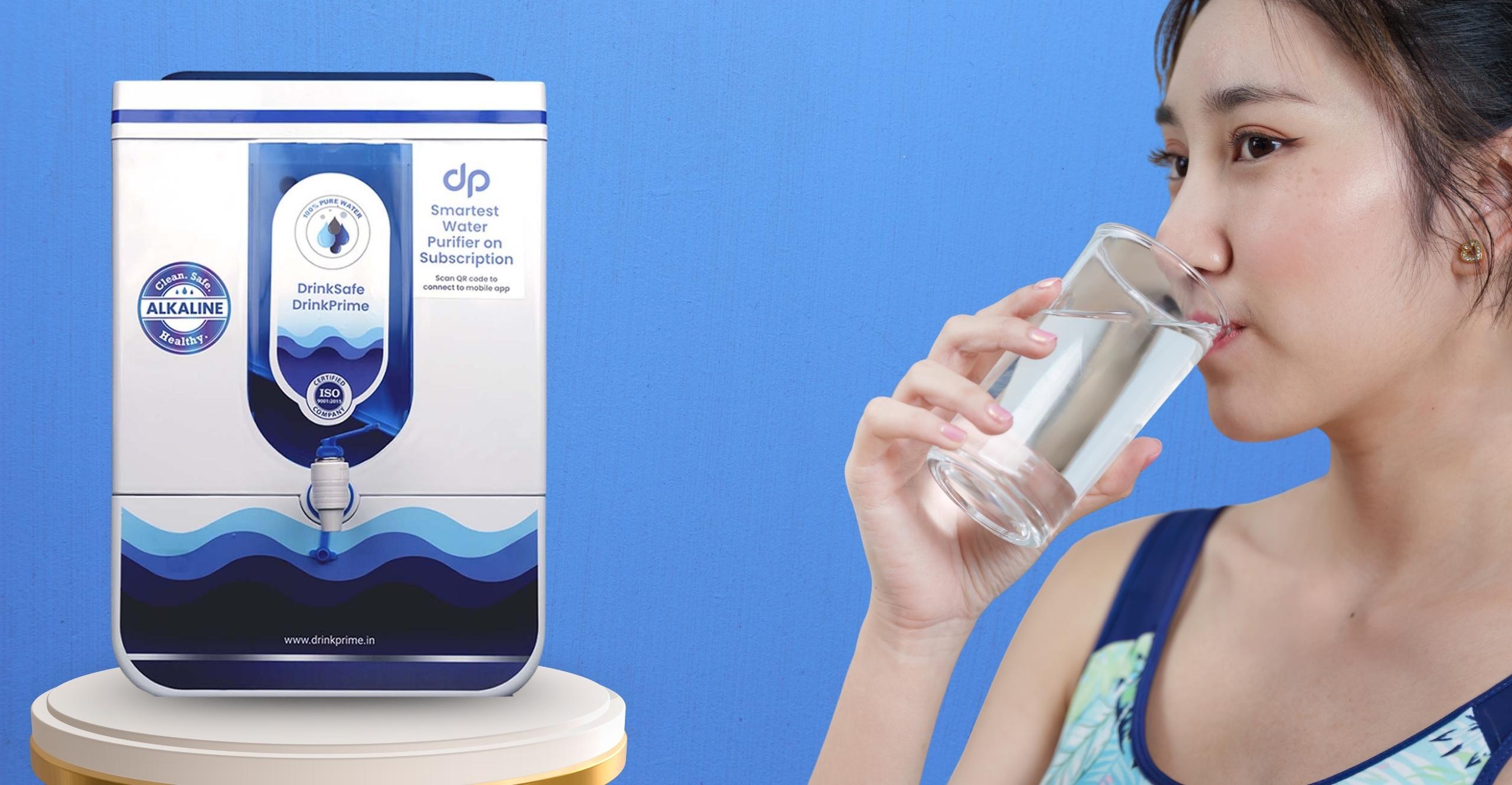
- DrinkPrime Alkaline: Has an alkaline cartridge that balances the water’s pH, so it doesn’t taste too acidic or harsh.
- DrinkPrime Mineral+: Adds back the good minerals that RO removes along with the dissolved solids.
- DrinkPrime UV: Made for homes with TDS below 200 ppm. It has UV only, with no RO stage, and neutralises bacteria and viruses.
- DrinkPrime Under-The-Sink: Made for compact kitchens or homes with no counter space. It’s installed inside a cabinet, and only a small tap is visible.
Does DrinkPrime offer a water filter? DrinkPrime offers purifiers, not standalone filters. Even the DrinkPrime UV purifier goes beyond a basic filter, since it neutralises bacteria and viruses.
All DrinkPrime purifiers are available on a rental basis. The monthly subscription starts at ₹349/month, with a refundable security deposit of ₹1,500. (Only the Under-The-Sink model has a security deposit of ₹1,999.) The rental covers the product, installation, delivery, maintenance and relocation.
Get 7 Days Risk Free Trial
Conclusion
So, who needs what? If your water is clean, your TDS is low and you trust your source, a filter may be enough for now, like it is for my mom. But if you live in a metro city, get borewell or tanker water, or your water changes with the seasons, a purifier is the safer choice. A filter catches what you can see. A purifier takes care of what you can’t.
The simplest way to decide is to know your water. Check where it comes from, test the TDS and then pick. And if you’d rather not worry about it, DrinkPrime takes care of the rest.
Frequently Asked Questions
1. What is the difference between a water filter and a water purifier?
A filter physically removes dirt and suspended particles. A purifier goes further and removes or neutralises dissolved impurities, bacteria and viruses.
2. Is a water filter safe for drinking water?
It depends on your water. For clean, low-TDS water from a trusted source, a filter can be a basic option. But it doesn’t deal with bacteria, viruses or dissolved impurities, so it may not be enough for every home.
3. Do water filters remove bacteria and viruses?
Usually not. Most basic filters only catch dirt and particles. Neutralising germs needs a UV or UF stage.
4. Does a water filter reduce TDS?
No. Sediment filters, candle filters and activated carbon don’t remove dissolved solids. For high TDS, an RO purifier is recommended.
5. Which is better, a water filter or a water purifier?
A purifier offers more complete protection, since it takes care of dissolved solids and germs as well. A filter can work for clean, low-TDS water, but a purifier is the safer pick for most city homes.
6. Can I use a water filter for borewell water?
It’s not recommended. Borewell water often has a high TDS, and a filter can’t bring it down. An RO-based purifier is a better choice.
7. Do I still need a purifier if my water looks clean?
Yes, it’s worth considering. Clear water can still carry bacteria and viruses, and a TDS reading doesn’t detect them. A purifier gives you protection from what you can’t see.