What is the full form of TDS? No, don’t Google it. I’m sure you have come across this word one too many times. If you’re reading a business newspaper or watching the Union Budget, there it is again. TDS!
Alas, it’s not the same TDS, though. The one related to business, which camouflages itself as the other, perhaps, means Tax Deducted at Source. That’s different from what you’re reading about.
This is Total Dissolved Solids. TDS, when it is related to water purification, stands for Total Dissolved Solids/Salts and is measured in parts per million (ppm) or milligrams per litre. For example, considering that the TDS level of a water sample is 250, it can be expressed as 250 ppm or 250 mg.
This guide has everything you need related to TDS. The one related to water. What does it mean, what are the safe levels, how is it measured, etc.
What does TDS mean in drinking water?
In drinking water, TDS means the amount of particles in terms of solids present in the water. It includes salts, minerals, metals, and everything else which dissolves in water. Even though you can’t see what it is, it can affect the taste and smell. It also affects the safety of the water you drink.
This is where it gets tricky. Not all TDS is bad, though. Naturally occurring drinking water contains essential minerals like calcium and magnesium. Since TDS measures every particle present in the water, the mere presence of these essential minerals also gives water a relatively moderate TDS.
TDS only tells you how much is dissolved, not what is dissolved. Low TDS doesn’t automatically mean the water is 100% safe. It may contain biological contaminants like bacteria or viruses which TDS doesn’t detect. High TDS also doesn’t mean the water is very harmful. It can also contain the good minerals that your body needs.
Reading a TDS meter tells you only one part of the story, not the whole.
What makes up the TDS in your water?
Basically, water tells you the story of everything it travels through. That is essentially what makes up your TDS as well. Naturally occurring water travels through rivers and lakes, and borewell water travels through pipes and metals before it reaches your tap. This often makes up your TDS because it dissolves everything it touches. Let’s now see what else in your water constitutes the TDS.
Water contains minerals like calcium, magnesium and potassium, which come from rocks and soil. Groundwater or borewell water is usually high in sodium, chlorides and sulphates. Water in coastal areas can taste salty because sea water mixes with groundwater. For example, water in Chennai is hard because of the sea water.
Water also contains small amounts of iron, manganese, copper and zinc, which are not harmful to health if consumed in small qualities. But, if the water contains other metals like lead, arsenic and fluoride, they can be dangerous to health.
Organic matter like decayed leaves, pesticides, fertilizer leach into the groundwater, which affect the water quality.
So, where does your water come from? Nature and human activity. This is why TDS can be completely different for two glasses in the same city. TDS depends on the water source. On the one hand, one glass can be very healthy because the high TDS can mean water is high in minerals. On the other hand, the other can be entirely different, because high TDS can also mean impure water.
What is a safe TDS level for drinking water?
There is no one magic number to say what is healthy and what is unhealthy.
DrinkPrime, India’s water company, says that anything in the range of 0-200 ppm is completely safe to drink. You can use a TDS meter to check what your water’s TDS range is. For quick reference:
- 0-200: Your water is completely safe to drink.
- 201-500: Your water is still acceptable as per BIS norms, but the water’s taste might be impacted.
- 500: Your water will taste salty and/or bitter, and needs purification.
Since TDS only tells you how much salt is dissolved in water and not what is dissolved, basic purification is recommended. High TDS is not necessarily harmful. Likewise, we cannot say that low TDS is automatically safe. DrinkPrime offers a range of water purifiers that are made for your city’s water. With DrinkPrime, you can make sure the water in your glass is completely safe to consume.
How to check TDS at home?
You don’t have to scratch your head to know what your water’s TDS is. A small TDS meter, which is affordable to buy, will make your job easier. This meter can be bought either online or offline.
How does a TDS meter work?
Dissolved minerals and salts carry a small electrical charge, so the more of them in the water, the better it conducts electricity. The meter’s two metal probes pass a tiny current through the water, measure how easily it flows, and convert that into a TDS number in ppm.
TDS only tells you how much is dissolved, not what is dissolved in it. A TDS meter also does not flag whether the water contains any biological contaminants like bacteria or viruses. If you’re unsure of your TDS reading, you can get your water source tested in a lab to understand exactly what it contains.
How to Reduce High TDS in Water?
If your tap water has a TDS above 500 ppm, the use of an RO purifier is recommended. RO (Reverse Osmosis) can effectively remove all the dissolved solids. Many common home methods may not be able to effectively reduce TDS.
What works?
- Reverse Osmosis (RO): This is decidedly one of the most effective ways to bring down the TDS level of your water. RO uses high pressure to pass water through a membrane. Dissolved solids get left behind.
- Distillation: Water is boiled, and the steam is collected and cooled back into liquid, leaving the solids behind. This may be impractical for everyday drinking because it uses up a lot of energy and gives you low-mineral water.
- Deionisation and ion exchange: These use special resins to swap out dissolved ions. They are used in some industrial and laboratory setups and in water softeners, which reduce hardness. They are not usually solutions for common water problems at home.
What doesn’t work?
- Boiling: Boiling is a great way to kill the germs, but it does nothing to dissolved solids.
- Sediment filters, candle filters and activated carbon: They are effective purification stages in a purifier, but they don’t remove dissolved impurities.
- UV and UF purifiers: UV neutralises bacteria and viruses and UF (Ultrafiltration) removes microbes. They don’t remove dissolved solids. UV purifiers can be used if the TDS reading is in the range of 0-200 ppm. DrinkPrime has a UV variant, which uses a UV (ultraviolet) LED to neutralise the bacteria. This variant does not have the RO purification stage.
Other Meanings of TDS
Searching for TDS on the internet can lead you to different pages. One of them would be a page on Tax Deducted at Source. In this guide, however, TDS means Total Dissolved Solids. Since the other TDS has nothing to do with water, it is a common source of confusion.
How DrinkPrime Helps?
As mentioned above, DrinkPrime has different purifiers catering to your city’s water. The products are Copper, Alkaline, Mineral+, UV and Under-The-Sink. Because 100% RO, which DrinkPrime follows, strips the water of essential minerals, a mineral cartridge always adds back calcium and magnesium to the RO-treated water.
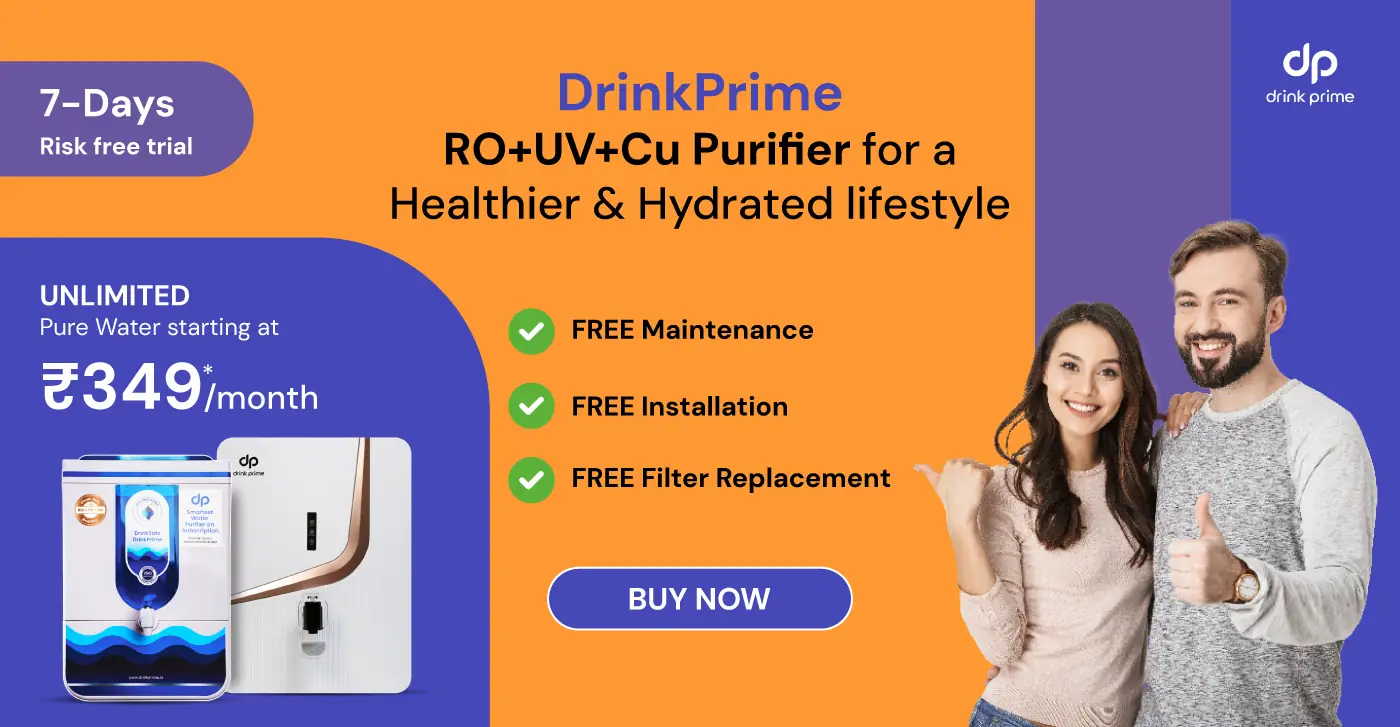
DrinkPrime’s purifiers are available on a rental basis. The monthly subscription starts at ₹349/month, with a refundable security deposit of ₹1,500. (Only the Under-The-Sink model has a security deposit of ₹1,999).
All recharges can be made on the app, and the app also helps you track your filter’s health and total water usage.
The best part is that the rental covers the product, installation, delivery, maintenance and relocation. If your purifier runs into an issue, the company will look into it for you at no extra charge.
Get 7 Days Risk Free Trial
Conclusion
Now that you know what TDS means and what it indicates, you can decide whether to get a water purifier to fulfil your water needs. Because of heavy pollution in metro cities like Bengaluru, Delhi and Chennai, your water straight from the tap may not be completely safe to drink. An intervention in the form of a purification method is usually suggested.
DrinkPrime’s purifiers have multi-stage purification including RO, UV and a mineraliser cartridge to add back the essential minerals.
Always keep in mind that a TDS reading is just the first step in analysing the problem. The rest can be taken care of by DrinkPrime.
Frequently Asked Questions
1. What is the full form of TDS?
In water, TDS stands for Total Dissolved Solids
2. Is low TDS water better?
Not automatically. Low TDS doesn’t mean the water is free of bacteria or viruses. Very low TDS can also taste flat and means fewer minerals, which is why a mineraliser adds calcium and magnesium back after RO.
3. Does boiling reduce TDS?
No. Boiling kills germs but doesn’t remove dissolved solids.
4. Do UV or UF purifiers reduce TDS?
No. UV neutralises bacteria and viruses and UF filters out microbes, but neither removes dissolved solids. Only RO, distillation and ion exchange do.
5. How accurate is a TDS meter?
It estimates TDS from how well the water conducts electricity, so it’s a good quick check, not a lab result. It can’t detect bacteria or tell you which minerals or metals are present.
6. What is the difference between TDS and water hardness?
TDS is the total of everything dissolved. Hardness is mainly the calcium and magnesium content.
7. How often should I check my TDS?
When you move to a new home, when your water source changes, after the seasons change if you use borewell water, and after servicing your purifier to confirm it’s working.